Powered by People: Taylor Ross
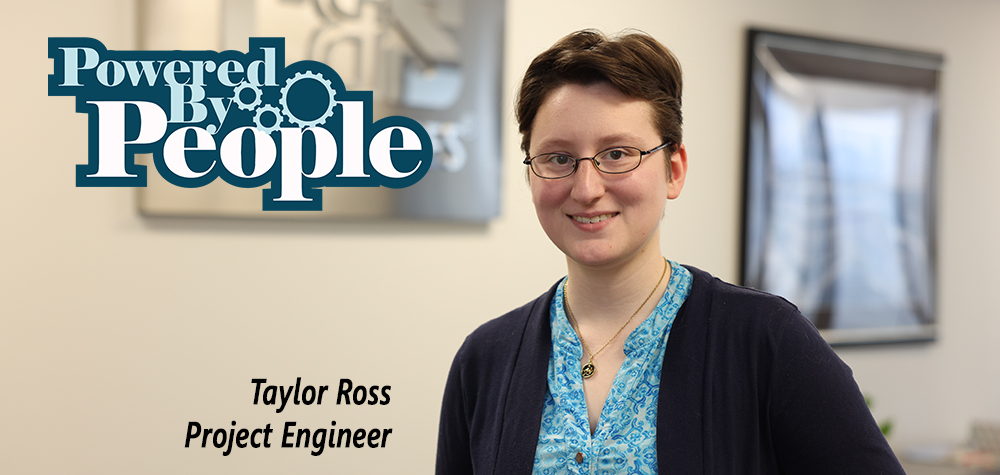
When mechanical engineer Taylor Ross talks about her work, she doesn’t start with boiler plants, energy models, or state funding programs, even though she works with all of those things on a daily basis. She starts with something simpler: Understanding what the priorities are.
“I want to help our clients find a way to simultaneously meet their goals and lower their energy usage, and these are not mutually exclusive endeavors.”
For Taylor, energy work isn’t abstract; it’s quantifiable and widely applicable across various project types. It’s about giving schools, hospitals, airports, and communities the information they need to make smart choices, which can lower operating costs, improve comfort, reduce emissions, and set them up for long‑term success.
And for the past seven years at C&S, Taylor has been doing exactly that.
Finding Her Way Into Energy

Taylor didn’t originally envision herself being an energy engineer. During her time at Rensselaer Polytechnic Institute, she studied mechanical engineering because it felt intuitive and it left the door open for many potential career paths. She wanted to make a positive impact, but worried that might need to be exchanged for stability in her career.
She considers herself fortunate to have found an internship with C&S, as it helped highlight an entire industry that was generally missing from classroom discussions. Understanding the flow and consumption of energy was a natural extension of thermodynamics.
“The work is never dull, since every facility is unique,” Taylor explains. “Our estimates always start with the basic equations, which are tweaked to work with information we have; it’s like a puzzle.” Innovation also helps keep the field interesting, as old technologies find new life with improvements in their implementation.
A Career Built on Data, Curiosity, and Problem‑Solving
Today, Taylor’s work stretches across a surprisingly wide range of facilities. She has completed energy audits for everything from town halls to train stations to manufacturing complexes. She has performed energy modeling for libraries, offices, and terminal buildings. She has supported sustainability master plans for universities and airports, and she has helped over thirty school districts plan for the transition to electric bus fleets.
A few of the projects that stand out to her include:
- A study at Rochester Institute of Technology, where she monitored energy usage across their 4.7 million square feet campus. She developed a program which processed over 15 million data points monthly, to identify deficiencies and prioritize buildings for improvements.
- An energy model for the terminal building of Ithaca Tompkins International Airport, presenting the energy savings and pay-back associated with installing a geothermal heat pump.
- A multi-facility energy audit for the Central New York Regional Transportation Authority (CENTRO) to identify BuildSmart 2025 emission reduction opportunities.
- A comprehensive fleet electrification plan for Gouverneur CSD, which led to the district piloting two electric buses.
What ties all of this work together is her curiosity. If she doesn’t know the answer, she’ll take the steps needed to figure it out. She leans on industry experts to help accurately establish existing conditions as well as the future possibilities.

Using Technology to Guide Clients Forward
Taylor’s toolkit is equal parts technical and creative. She uses eQuest and Insight to build energy models that test different system scenarios, evaluate insulation levels, compare HVAC options, and estimate long-term performance and cost savings. Those models become the backbone of client conversations.
Spreadsheet calculations are used for most projects and are tailored to the unique qualities of each facility or fleet. However, she also uses Python to help automate data analysis, especially when she’s dealing with large sets of trend data.
The most important part, she says, is turning that information into something people can use.
“Our reports need to be properly understood so our clients can make well-informed decisions. Oftentimes that means we’re incorporating tables, charts, and infographics so it’s easier to digest,” Taylor notes.
Collaboration at the Center
Energy work doesn’t happen in a vacuum. Taylor’s projects often involve facilities staff sharing the realities of daily operations, planners thinking about long-term capital improvements, architects revising building layouts, and electrical engineers analyzing power capacity.
Her role is to connect those dots and to make sure the recommendations she develops fit the building, the people who run it, and the community it serves. She also says, “it’s essential to work together and create buy-in across organizations for these projects, so that they have the best chance possible of moving to implementation.” Doing this also can help address potential snags early and keep things moving smoothly.

Improving Communities, One Project at a Time
The impact of Taylor’s work can be seen in a lot of different places: a rural town hall installing a heat pump to no longer be reliant on fuel oil, a school district piloting their first electric bus, and a hospital proactively replacing their ventilation systems with something more efficient.
“People spend the majority of their time inside. These projects are typically viewed as an expense, but they’re also an opportunity to improve our lives.”
Her work lowers operating costs. It reduces emissions. It improves indoor comfort. It helps communities qualify for grants that make projects possible. And in many cases, it provides clarity during major transitions, like electrification and decarbonization, that can otherwise feel overwhelming.
Looking Ahead
Despite the withdrawal of federal funding, there is still a growing interest in sustainability. State and local governments are now leading the charge on these efforts. With this growing interest, Taylor sees the demand for energy engineering rising at an unprecedented rate.
She’s excited about the growing popularity of cheap solar power, campuses planning their approach to long‑term decarbonization, and communities coming together to build shared thermal energy networks. She loves that her work lets her support everyone from small towns to major institutions.
Most of all, she’s excited about the role she gets to play.
“The choices we help clients make now will shape these buildings and campuses for decades,” she says. “It feels good to know I’m making a quantifiable difference in reducing the long-term impacts of climate change.”