Highway Facility Design – An Integrated Approach
How an integrated, operations‑first approach delivers long‑term value for public works agencies
Highway and maintenance facilities are among the most mission-critical, but also the most neglected, assets a municipality owns. They support daily operations, emergency response, fleet maintenance, material storage, and staff wellbeing—often all within a single, highly active campus. Yet many communities are still operating from facilities designed decades ago, no longer aligned with today’s operational demands, safety standards, or energy expectations.
Additionally, properly planned facilities save municipal dollars and provide a greater return on investment for taxpayers. Housing expensive vehicles indoors, especially during the winter months, greatly extends their useful life. Coupled with ease of performing routine maintenance, this saves downtime, increases operational efficiency, and reduces replacement costs.
Drawing on years of experience delivering highway and public works facilities across the country, C&S has developed a design approach grounded in a simple idea: facilities should actively support how departments operate today while remaining flexible enough to adapt tomorrow. We’ve identified several design principles and process elements that consistently deliver value for our municipal clients.
These elements are readily transferable to other public works projects seeking efficiencies, cost control, and long-term resilience.
Starting with operations, not square footage
Successful facilities begin with an understanding of day-to-day operations. Rather than beginning with a fixed building size or a predefined layout, C&S starts by listening—working closely with superintendents and administrative staff to understand daily workflows, seasonal demands, and operational pain points.
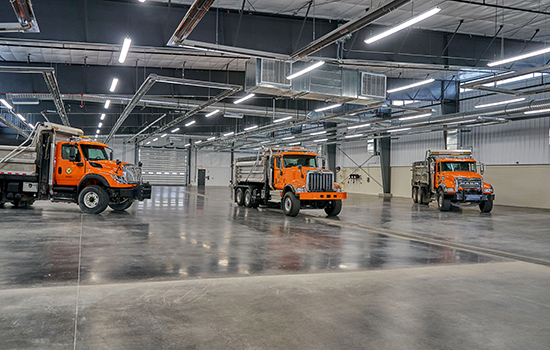
Conversations typically focus on:
- Fleet mix and circulation through the building and site
- Maintenance workflows and seasonal operations
- Separation of “clean” and “dirty” spaces
- Staff amenities that support safety and productivity
This operational focus helps right-size facilities—often revealing opportunities to reduce unnecessary square footage while improving functionality. For many clients, this approach has unlocked cost savings without compromising capability, ensuring municipal dollars are spent where they matter most.
In cases where budget constraints prevent the construction of all required square footage, buildings and sites are designed to accommodate future expansion. This is important regardless of budget, as municipal needs change and road miles may grow with population increases.

Integrated campus and site planning
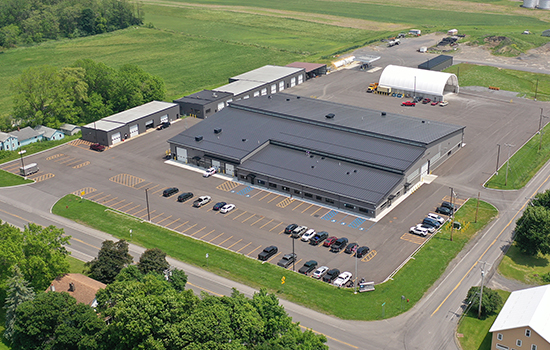
Highway facilities rarely consist of a single building. Fueling stations, salt and brine storage, cold storage, material stockpiles, and future expansion areas must all work together safely and efficiently.
An integrated campus approach brings architecture, site/civil engineering, utilities, environmental considerations, and traffic planning together from the start. This results in sites that:
- Support intuitive, safe vehicle movement
- Reduce conflicts between staff, fleet, and visitor traffic
- Allow for phased construction or future growth
This approach is particularly valuable on constrained or previously developed sites, where operational continuity during construction and long-term flexibility are essential.
Designing for constructability and cost certainty
For municipal owners, cost predictability is often just as important as the final design. Our approach emphasizes detail-driven, highly coordinated construction documents developed using advanced 3D and BIM tools to reduce uncertainty. By identifying conflicts early, before contractors even bid the work, teams can:
- Reduce contractor confusion during bidding
- Minimize change orders during construction
- Provide clearer, more competitive bid pricing
Constructability reviews informed by in‑house construction experts further ensure that designs are practical, buildable, and aligned with local market conditions.

Maintaining operations during phased construction
Highway departments can’t simply shut down while new facilities are built or existing ones are renovated. Snow removal, road and park care, bridge and drainage replacements, emergency response, and fleet maintenance must continue uninterrupted. Phased construction, temporary relocation strategies, and carefully sequenced site logistics are a core part of C&S’s approach.
Our teams routinely develop clear, contractor-friendly phasing plans tailored to each department’s operational realities. These plans allow departments to continue serving residents throughout construction while maintaining safety for staff, the public, and construction personnel and ensuring transitions into new facilities happen smoothly.
Common strategies include:
- Temporary circulation and access planning
- Dedicated construction zones
- Clear contractor phasing documents

Energy efficiency that delivers real returns
Energy performance has a direct impact on long‑term operating budgets. Our highway facility designs integrate energy considerations early, focusing on:
- Durable, low-maintenance envelopes
- Efficient mechanical systems suited to high-bay and vehicle service environments, including geothermal
- Opportunities for renewable energy integration
Our in-house energy expertise enables us to move beyond rule-of-thumb solutions and perform project-specific energy analyses that balance first cost with lifecycle performance. Where appropriate, we also help clients leverage available incentive programs and funding options to offset upfront investments.
Leveraging technology for better decision-making
From 3D visualization for public meetings to laser scanning of existing facilities, technology plays a critical role in improving clarity and collaboration. These tools help stakeholders:
- Visualize design decisions early
- Make informed choices before costs are locked in
- Communicate design intent clearly with governing boards and the public

Our teams use these technologies not as add-ons, but as integral parts of a collaborative, transparent design process. Used thoughtfully, this state-of-the-art technology helps align expectations and streamline approvals.
Communication as a project delivery tool
Across all our highway facility projects, clients consistently point to communication as a differentiator. Regular coordination meetings, clear progress reporting, and visual tools keep everyone—from highway staff and taxpayers to elected officials—informed of where the project stands and why decisions are being made.
This emphasis on knowledge sharing builds trust, accelerates approvals, and helps align expectations.
A transferable framework for public works success
While every municipality faces its own constraints and priorities, the core elements of our highway facility design approach remain consistent: listen first, integrate disciplines early, design with operations in mind, and plan beyond opening day.
For public works leaders and municipal decision-makers, adopting these principles can transform highway facilities from aging liabilities into resilient assets—facilities that not only meet today’s needs, but continue delivering value for decades to come.
For more information, reach out to Mike LaMontagne.