Powered by People: Ryan Merry

C&S’s greatest strength has always been our people. Every project begins with the creative, knowledgeable, and passionate individuals who contribute to the work we do. Powered by People is our way of celebrating the talented professionals who bring ideas to life — the planners, designers, engineers, constructors, and specialists whose stories shape the communities we serve.
Seeing What’s Possible: How Ryan Merry Brings Projects to Life
For Senior Visualization Designer Ryan Merry, the goal is simple: turn complex architectural and engineering drawings into accessible, compelling images. His work bridges the gap between the technical and the expected result, ensuring clients, communities, and project teams understand the destination long before construction begins.
From early concept sketches to high-fidelity models, Ryan transforms technical plans into visuals that are intuitive and realistic. This clarity allows stakeholders to see themselves in the design—often the catalyst for the most critical project decisions.
Turning Data into Design

Ryan’s role begins where the technical data ends. He takes engineering drawings, site layouts, and design specs—often difficult for a layperson to interpret—and translates them into environments that are immediately understandable.
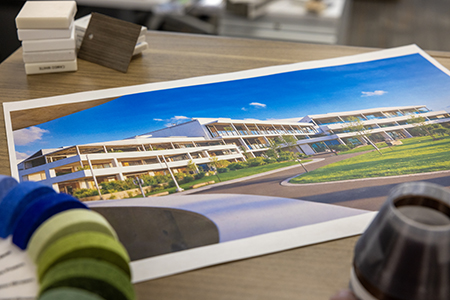
Using a combination of 3D modeling, material studies, and architectural rendering, he refines proportions, lighting, and context. The result is a view that mirrors how a space will truly feel, rather than just how it fits on a plan sheet.
These renderings often serve a dual purpose: quality control, and marketing. Creating a realistic rendering frequently reveals coordination conflicts or design opportunities that flat drawings miss. Catching these shifts early reduces rework and improves constructability, making visualization a tool for problem-solving, not just presentation. For clients, it allows an immediate understanding of scale and flow, encourages better questions and more confident decision-making, and can be used to sell the idea and build excitement.
Creativity Grounded in Accuracy
While the output is artistic, the foundation is strictly technical. Visualization must respect engineering realities; dimensions, grading, utilities, and structural constraints dictate the boundaries of the image.
“My end goal is a realistic representation of the project, staying true to the designers intent. The star is the project and ultimately the construction documents, not the renderings,” Ryan explains. “Occasionally the end goal will be an image used for marketing, that’s when the artistic side moves to the front, creating a more dynamic compelling image that tells more of a story.”

A Collaborative Process
Authentic visualization requires input from every discipline. Ryan partners closely with planners, architects, engineers, and landscape designers to ensure the imagery reflects the full project intent—from structural constraints to community priorities.
“Visualization is the easiest way to understand a project,” he notes. “So accuracy is key; a misrepresentation can lead to mistakes or confusion.”
Helping Clients Connect
The practical impact of visualization is its ability to generate meaningful feedback. When clients and community members can clearly picture how they will move through or work in a space, they provide insights that shape the project for the better. Whether it’s refining a circulation pattern or adjusting a public entry, these visuals align the project team and the stakeholders, fostering a shared sense of ownership.
Integrating AI in the Workflow
As the industry evolves, Ryan is integrating AI tools to enhance the design process. Rather than replacing traditional workflows, AI serves as an accelerator—generating textures, testing lighting scenarios, and iterating concepts rapidly.
This allows for faster exploration in the early stages, freeing up time for high-level refinement.
“While AI in concept development is fun, it can only take the design so far. The decision making and ideas still come from the designer. I primarily use AI as a finishing tool, adding small details that would be too cumbersome to add by hand, but really increase overall realism.”
By combining these emerging tools with established design principles, Ryan ensures that visualization remains a reliable asset: accurate, empathetic, and focused on helping people see a future they can believe in.